Blind AI Agents: How Desearch Solves Challenges
Blind AI Agents: How Desearch Solves Challenges
Artificial Intelligence (AI) has made groundbreaking strides across tons of domains - from healthcare to robotics to fully autonomous systems. But even with all that progress, one core problem still holds a lot of AI agents back: most of them are basically blind.
These "blind AI agents" operate without direct access to structured knowledge, curated datasets, or steady information streams. They're thrown into the wild where relevant data is scattered, unstructured, constantly changing, and often locked behind outdated APIs or slow retrieval systems.
This is exactly where Desearch, built on top of the decentralized compute power of Bittensor, steps in. By tapping into Bittensor's network of globally distributed miners, Desearch delivers a scalable, real-time search layer that gives blind agents the visibility they've never had before.
In this article, we'll break down what blind AI agents really are, the retrieval barriers they face in fast-moving environments, and how Desearch + Bittensor together unlock the missing piece — enabling AI agents to operate with live, adaptive, always-fresh data instead of flying in the dark.
Understanding Blind AI Agents: Challenges and Limitations
Blind AI agents are designed to operate independently in environments where they don't have immediate access to predefined, static datasets. Unlike traditional AI models that rely on fixed training data, these agents must dynamically retrieve, interpret, and synthesize information from diverse sources. While this flexibility opens up vast possibilities, it also introduces significant hurdles:
1. Navigating Vast and Unstructured Data
Blind AI agents often need to deal with an overwhelming volume of data, much of which is poorly labeled or inconsistently formatted. This unstructured nature makes it difficult to extract actionable insights quickly.
2. Latency in Real-Time Processing
Efficiency is critical for tasks like real-time search or decision-making. Blind AI agents often struggle with high latency when querying and processing data from multiple platforms.
3. Complex Integrations Across Platforms
In a world where data exists across countless silos - APIs, databases, and web platforms - blind AI agents need seamless integration capabilities. However, managing these integrations without introducing errors or bottlenecks is a daunting task.
4. Scalability and Cost Management
As the use of AI scales, so do the associated costs, especially for blind agents that require continuous data retrieval. Optimizing cost efficiency while maintaining performance remains a pressing concern.
These challenges underscore the need for a robust framework that can streamline data retrieval, reduce latency, and improve operational efficiency. Enter Desearch, a transformative tool designed to address these very needs.
How Desearch Empowers Blind AI Agents
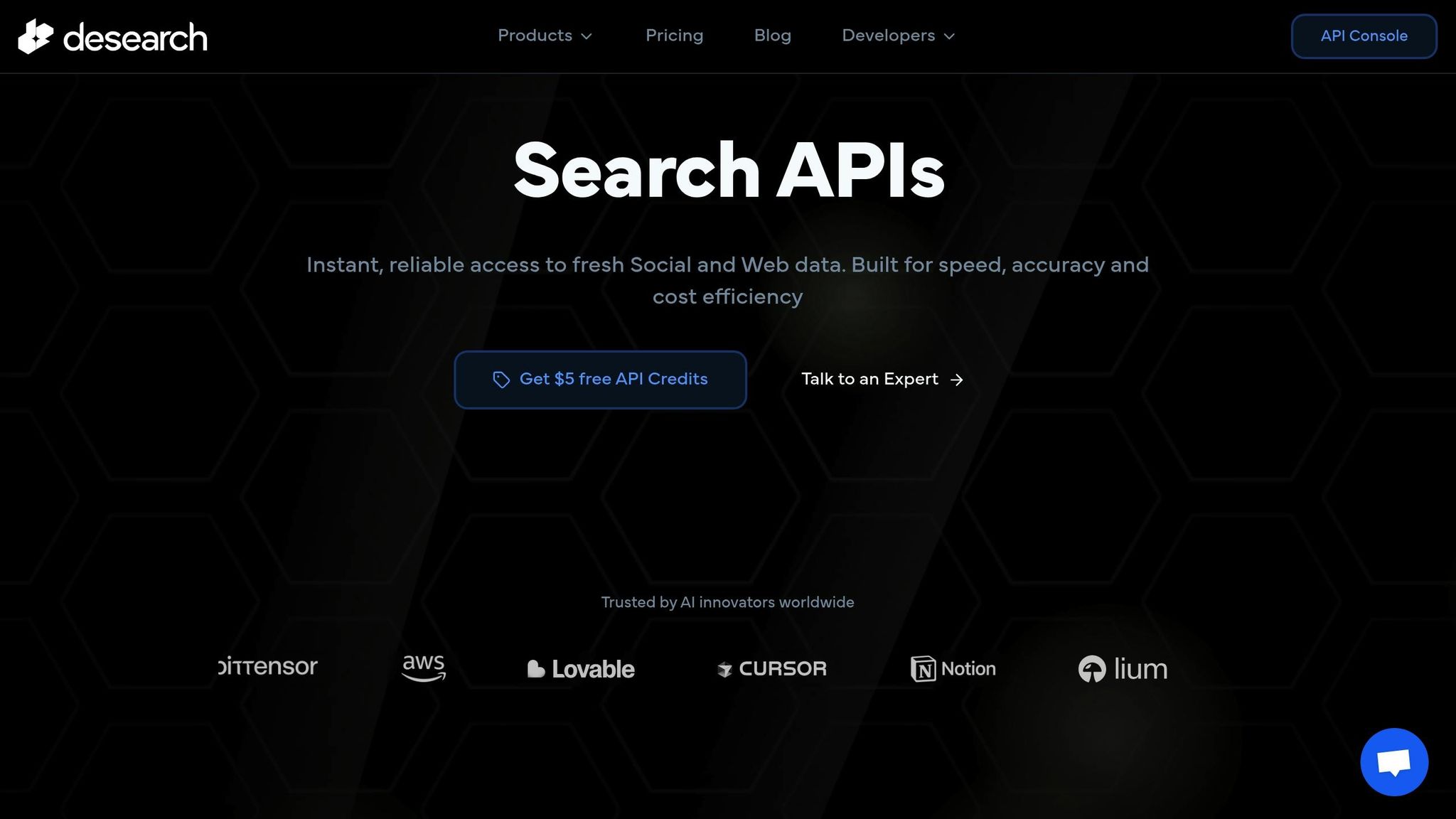
Desearch offers a specialized solution aimed at revolutionizing the way blind AI agents access and process data. Its powerful capabilities simplify the inherent complexity of real-time search and cross-platform integrations, making it an indispensable tool for developers and researchers.
1. Unified Real-Time Search
Desearch acts as a bridge between blind AI agents and the fragmented data landscape. By providing a unified search interface, it enables agents to query multiple data sources simultaneously. This real-time capability ensures that agents can retrieve and process relevant data in fractions of a second, eliminating the bottlenecks associated with traditional search methods.
2. Structuring the Unstructured
One of Desearch's standout features is its ability to structure unorganized data on the fly. Whether the input consists of text, images, or any other format, Desearch excels at converting it into actionable insights. This is especially valuable for blind AI agents tasked with making sense of chaotic or incomplete information.
3. Seamless Cross-Platform Integration
Desearch simplifies the complex task of integrating with various APIs and data repositories. It acts as a universal connector, allowing blind AI agents to interact with multiple platforms without requiring extensive custom development. This ensures that agents can remain flexible and scalable as their use cases evolve.
4. Cost-Effective Scalability
Efficiency is at the core of Desearch's design. By optimizing query processing and minimizing redundancy, it reduces the computational demands on AI agents. This translates into lower operational costs for developers working on large-scale projects.
5. Accelerating AI Workflows
Desearch doesn't just provide data; it enhances how blind AI agents interact with workflows. By enabling faster and more accurate data retrieval, it accelerates decision-making processes and ensures that AI agents can respond effectively in real-time scenarios.
Real-World Applications of Desearch in Blind AI Systems
The potential applications for Desearch's capabilities are vast, spanning industries and use cases:
- Medical Diagnosis and Research: Blind AI agents can leverage Desearch to pull in the latest medical data and trends, aiding doctors in diagnosing rare conditions or recommending treatments.
- Customer Support Automation: AI chatbots can use Desearch to access up-to-date company policies, product catalogs, or troubleshooting guides, delivering accurate responses to customer queries.
- Financial Market Analysis: Blind AI systems in finance can utilize Desearch to aggregate and interpret market data from diverse sources, enabling smarter investment decisions.
- Autonomous Exploration: In robotics, blind AI agents can rely on Desearch to navigate unfamiliar environments by retrieving real-time mapping and contextual data.
Key Takeaways
To summarize, here are the most important insights about Desearch and its role in supporting blind AI agents:
- Unified Data Access: Desearch provides a centralized platform for querying data from multiple sources in real time.
- Improved Data Structuring: It excels at transforming unstructured data into usable formats, enabling faster decision-making.
- Reduced Latency: By optimizing real-time search processes, Desearch minimizes delays, critical for time-sensitive applications.
- Seamless Integration: Desearch eliminates the technical hurdles of connecting with diverse APIs and platforms.
- Cost Efficiency: Its optimized design ensures scalability without inflating development or infrastructure costs.
- Versatility Across Domains: From healthcare to finance, Desearch empowers blind AI agents to operate effectively in a variety of industries.
Conclusion
Blind AI agents represent the next frontier in artificial intelligence, pushing the boundaries of independent, context-aware problem-solving. However, their effectiveness hinges on access to the right tools for overcoming key challenges like unstructured data, latency, and scalability. Desearch emerges as a game-changing solution, equipping these agents with the capabilities they need to navigate complex, fragmented data landscapes.
For developers, technical teams, and startups aiming to build or optimize AI-driven tools, integrating Desearch into your workflows can transform how your systems interact with data. By bridging the gap between information retrieval and actionable insights, Desearch not only empowers blind AI agents but also paves the way for innovative, scalable, and efficient AI applications.
Source: "The Solution to Blind AI Agents | Subnet 22 at Novelty Search" - Desearch AI, YouTube, Dec 4, 2025 - https://www.youtube.com/watch?v=fI01vokHOh8
