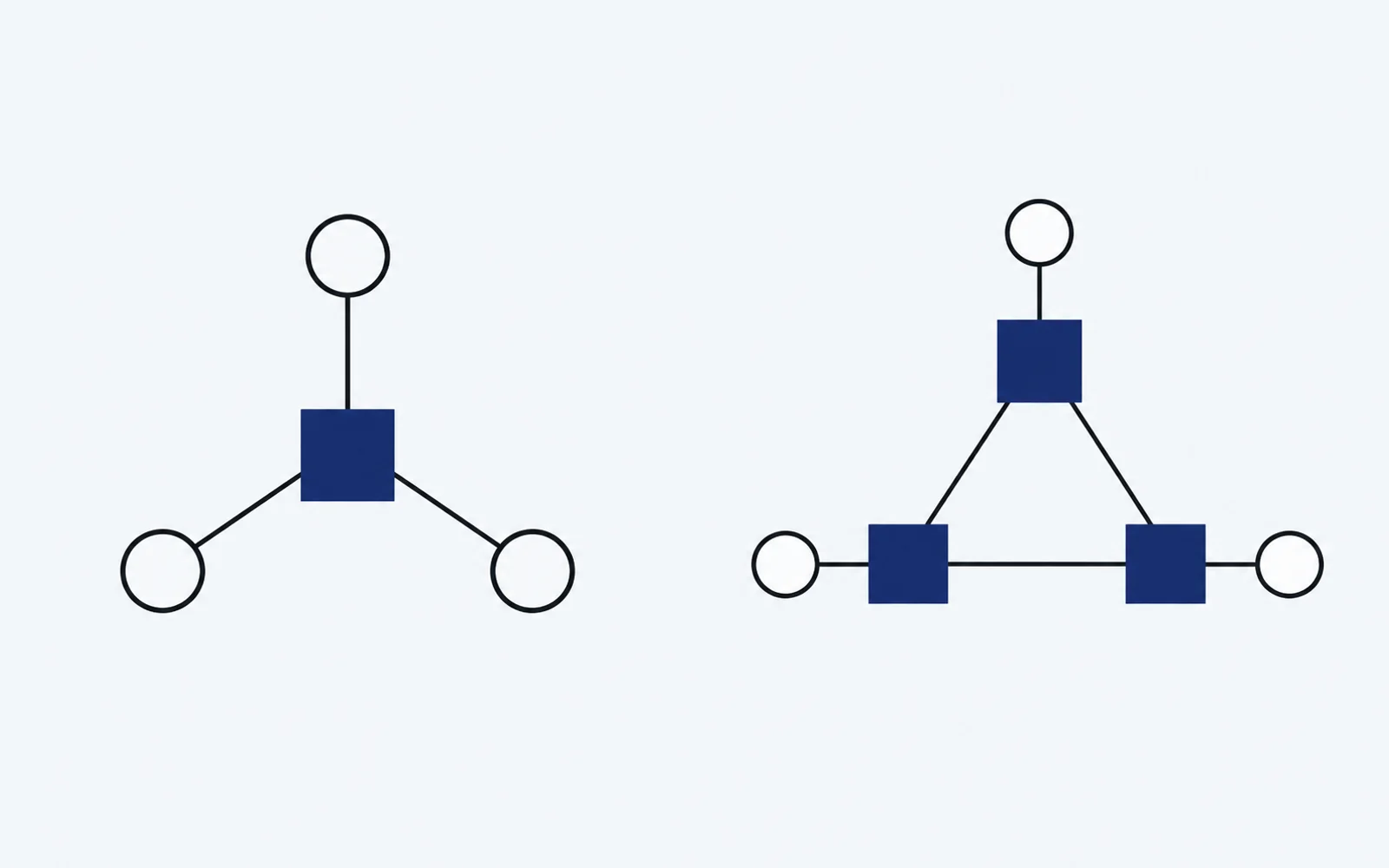
Most developers today rely on centralized search APIs. They're easy to start with and often work well early on. But as products scale, the trade-offs become harder to ignore.
This article explores the difference between centralized and decentralized search APIs and why Desearch AI takes a fundamentally different approach.
Desearch is a decentralized search API built on the Bittensor network, designed for developers who care about reliability, transparency, and long-term scalability.
-
Desearch: https://desearch.ai/
-
Bittensor: https://bittensor.com/
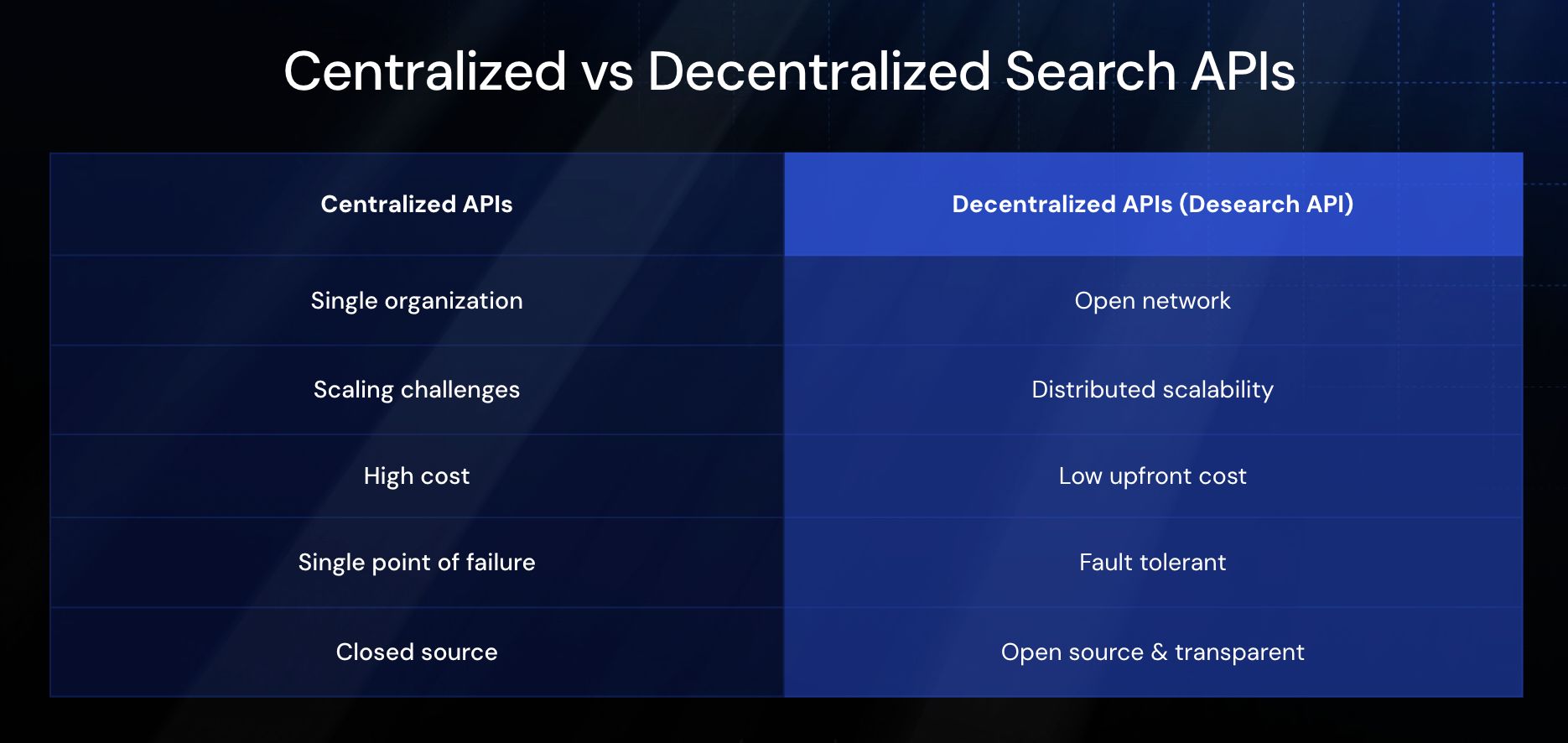
Centralized Search APIs
Centralized search APIs are operated by a single organization.
-
One company owns the infrastructure
-
One company controls the data sources
-
One company sets pricing, limits, and policies
This model is convenient at the beginning, but it introduces structural risks as usage grows.
Single-Organization Control
When one company controls the API, developers are fully exposed to its decisions. Pricing changes, rate limits, or policy updates can break products overnight—often with little warning and no alternative path.
Scaling Constraints
As demand increases, centralized providers must scale their own infrastructure. To manage load and protect margins, this frequently results in stricter rate limits or rapidly increasing costs passed on to developers.
Cost at Scale
Centralized search APIs tend to become expensive as usage grows. You're not just paying for queries you're also paying for proprietary infrastructure, internal margins, and usage restrictions.
Single Point of Failure
If the provider experiences downtime, your application does too. There is no redundancy and no fallback.
Closed Systems
Most centralized APIs are black boxes. Developers cannot inspect how data is collected, ranked, filtered, or prioritized, making it difficult to reason about result quality or long-term reliability.
Decentralized Search APIs with Desearch
Desearch follows a different model.
Instead of relying on a single provider, search is powered by an open network of independent participants competing to deliver the best results.
Open Network Participation
Anyone can participate in the Desearch network as a data provider or validator. No single entity controls search results, ranking logic, or data flow.
Distributed Scalability
As demand grows, more providers can join the network. Capacity scales with participation rather than being constrained by one company's infrastructure.
Usage-Based Costs
Developers using the Desearch API pay only for what they use. Competition at the network level helps keep costs efficient while the complexity of infrastructure is handled by the protocol.
Fault Tolerance by Design
There is no single point of failure. If some providers go offline, others continue serving results without disruption.
Transparent and Inspectable
Desearch Subnet 22 is open source at the protocol level. Developers can inspect how incentives, validation, and scoring work.
Validator and scoring code:
https://github.com/Desearch-ai/subnet-22/tree/main/neurons/validators
Why Decentralization Improves Search Quality
Decentralization isn't only about infrastructure, it directly impacts result quality.
-
Multiple providers respond to each query
-
Validators compare and score results
-
High-quality results earn more rewards
This creates continuous competitive pressure. Weak approaches are naturally filtered out, while stronger ones are reinforced.
Quality is enforced by incentives, not trust.
To understand how decentralized search works in practice, it helps to look at the underlying architecture. In the next article, we break down what a decentralized search engine actually is and how Desearch is building one.
How Developers Use Desearch
From a developer perspective, Desearch remains straightforward.
-
Send a query to the API
-
The network routes it to multiple providers
-
Results are evaluated and ranked
-
Structured data is returned
There's no need to manage crawlers, scraping pipelines, or ranking systems. Developers interact with a simple API while the network handles execution and optimization.
Built on Bittensor Subnet 22
Desearch operates as Subnet 22 on the Bittensor network.
Bittensor provides the incentive framework that allows independent participants to compete fairly. Desearch specializes this framework specifically for search and fresh data retrieval.
Together, they form an open search layer that improves as usage and participation increase.
Final Thoughts
Centralized search APIs optimize for control.
Decentralized search APIs optimize for resilience, transparency, and long-term quality.
Desearch offers a practical alternative, giving developers access to search without locking them into a single provider or opaque system. As applications and AI agents increasingly depend on fresh, reliable data, decentralized search shifts from an experiment to a necessity.